


Industry News
A domestic company released a new product
Views : 782
Author : JIUZHOU
Update time : 2022-10-14 10:03:50
A domestic company released the industry's first 400G ER4 QSFP56-DD optical module based on a single-wavelength 100G non-coherent solution, which meets the transmission distance of 40km and is suitable for medium and long-distance 400G business application scenarios such as DCI and metropolitan area networks.
Recently, a domestic company released the industry's first new 400G 40km optical module based on a single-wavelength 100G non-coherent solution - 400G ER4 QSFP56-DD optical module.
At present, 400G long-distance transmission optical module products mainly include incoherent and coherent solutions. On the one hand, the 400G ER4-lite transmission distance of the non-coherent solution is short, and it is difficult to meet the application requirements of the metropolitan area; on the other hand, the 400G optical module products of the coherent solution can meet the long-distance transmission, but the core technology is mainly used by a few overseas manufacturers. To master, the technology relies heavily, the cost is high, and it is wasteful to use in the metropolitan area.
Compared with the existing coherent solution, the 400G ER4 incoherent optical module product of a domestic company has a significant cost advantage and a significant reduction in power consumption when it meets the transmission distance of 40km. It has strong market competitiveness in medium and long-distance 400G business application scenarios such as DCI and metropolitan area network.
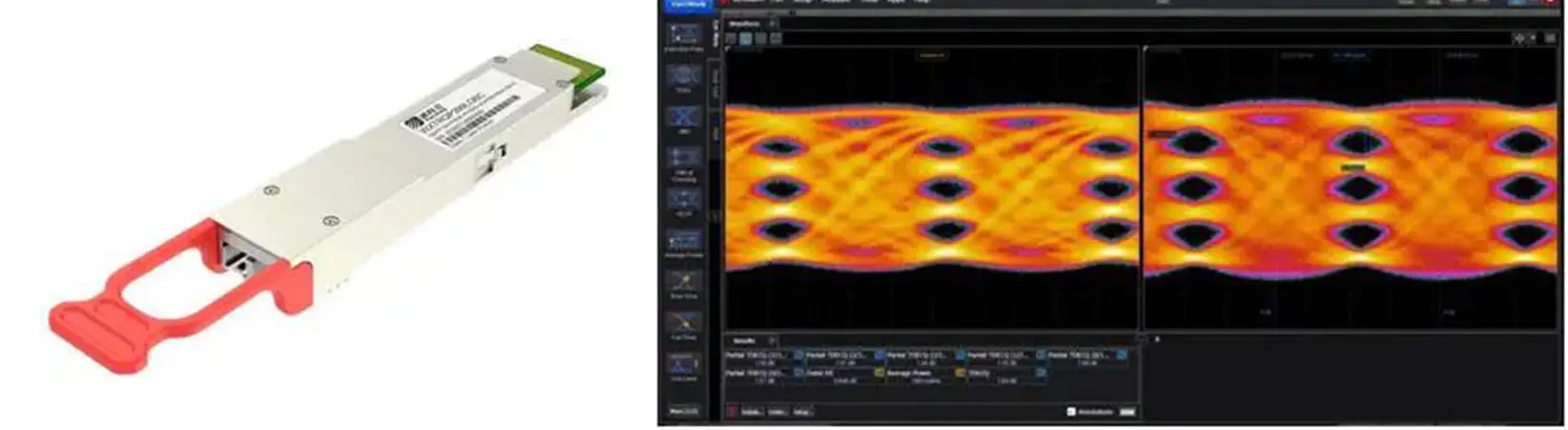
The 400G QSFP56-DD ER4 optical module of a domestic enterprise conforms to the QSFP-DD MSA protocol and adopts the standard QSFP-DD Type2 package. The electrical port side meets the IEEE 802.3bm 400GAUI-8 standard, uses 8x53G PAM4 encoded signals, and supports standard KP4 FEC RS (544,514). The optical port side uses dual LC fiber interfaces to transmit 4x10⁶G PAM4 encoded signals, the sending side uses 4 channels of 56Gbaud nLWDM EML lasers, the receiving side uses 4 channels of 56Gbaud receivers, and the SOA is integrated and packaged to meet the fiber link budget requirements. In terms of device packaging and process design, optimized design is carried out in combination with indicators such as coupling efficiency, optical output power, and signal integrity. While improving device integration and reducing product power consumption, it greatly improves transmission performance and effectively ensures 40km long-distance transmission of 400GE services.
At present, the product has completed the module-level test in the customer's 5G optical device laboratory. When KP4 FEC is turned on, there is no bit error after 72 hours of continuous fiber 40km correction, and the symbol error is less than 8. The test results show that the maximum power consumption of the optical module at full temperature is less than 12W; the OMA output power of each channel is greater than 4dBm, the receiving sensitivity is less than -16 dBm, and the link budget is much greater than the 40km transmission requirement. Optical fiber 50km transmission.
In the past 22 years, a domestic enterprise has focused on the field of optical communication transmission, insisted on independent innovation, and continuously integrated and iterated on the underlying technologies of optical modules, optical amplifiers, subsystems and other products. The deep vertical integration capability of subsystem design and manufacture, frequent new high-end products, and high-speed, long-distance carrier-class products have become an important competitive advantage for a domestic enterprise.
Recently, a domestic company released the industry's first new 400G 40km optical module based on a single-wavelength 100G non-coherent solution - 400G ER4 QSFP56-DD optical module.
At present, 400G long-distance transmission optical module products mainly include incoherent and coherent solutions. On the one hand, the 400G ER4-lite transmission distance of the non-coherent solution is short, and it is difficult to meet the application requirements of the metropolitan area; on the other hand, the 400G optical module products of the coherent solution can meet the long-distance transmission, but the core technology is mainly used by a few overseas manufacturers. To master, the technology relies heavily, the cost is high, and it is wasteful to use in the metropolitan area.
Compared with the existing coherent solution, the 400G ER4 incoherent optical module product of a domestic company has a significant cost advantage and a significant reduction in power consumption when it meets the transmission distance of 40km. It has strong market competitiveness in medium and long-distance 400G business application scenarios such as DCI and metropolitan area network.
The 400G QSFP56-DD ER4 optical module of a domestic enterprise conforms to the QSFP-DD MSA protocol and adopts the standard QSFP-DD Type2 package. The electrical port side meets the IEEE 802.3bm 400GAUI-8 standard, uses 8x53G PAM4 encoded signals, and supports standard KP4 FEC RS (544,514). The optical port side uses dual LC fiber interfaces to transmit 4x10⁶G PAM4 encoded signals, the sending side uses 4 channels of 56Gbaud nLWDM EML lasers, the receiving side uses 4 channels of 56Gbaud receivers, and the SOA is integrated and packaged to meet the fiber link budget requirements. In terms of device packaging and process design, optimized design is carried out in combination with indicators such as coupling efficiency, optical output power, and signal integrity. While improving device integration and reducing product power consumption, it greatly improves transmission performance and effectively ensures 40km long-distance transmission of 400GE services.
At present, the product has completed the module-level test in the customer's 5G optical device laboratory. When KP4 FEC is turned on, there is no bit error after 72 hours of continuous fiber 40km correction, and the symbol error is less than 8. The test results show that the maximum power consumption of the optical module at full temperature is less than 12W; the OMA output power of each channel is greater than 4dBm, the receiving sensitivity is less than -16 dBm, and the link budget is much greater than the 40km transmission requirement. Optical fiber 50km transmission.
In the past 22 years, a domestic enterprise has focused on the field of optical communication transmission, insisted on independent innovation, and continuously integrated and iterated on the underlying technologies of optical modules, optical amplifiers, subsystems and other products. The deep vertical integration capability of subsystem design and manufacture, frequent new high-end products, and high-speed, long-distance carrier-class products have become an important competitive advantage for a domestic enterprise.
Related News
Read More >>
 AI Data Center Optical Evolution: Trends & Market
Sep .20.2026
With the rapid growth of artificial intelligence computing, data centers now need much more bandwidth. The physical limitations of traditional copper cable connections are becoming increasingly apparent as transmission speeds rise.
 The Global OCS Market Will Exceed $8 Billion by 2030
Sep .09.2026
The latest industry forecasts indicate that by 2030, the total size of the global optical path switch market is expected to exceed $8 billion, with a compound annual growth rate (CAGR) of over 30% between 2026 and 2030.
 400G Single-Lane: Next Inflection for AI Datacenters
Aug .27.2026
400G per lane is the next inflection for AI data centers, boosting bandwidth and scaling, but requires advances in materials, packaging, and cooling.
 AI-driven 800G Ramp-up Amplifies Quality Risks
Aug .14.2026
Faced with a surge in orders, leading global manufacturers are increasing production line speeds and shortening delivery cycles. However, the real challenge of this growth goes beyond “can we deliver orders on time?”