


Industry News
Port Breakout and Ultraminiature Connectors: Sustainability in the Data Center
Views : 924
Author : JIUZHOU
Update time : 2022-10-28 10:17:31
Parallel Port Breakout and Subminiature Connector (VSFFC)
Helping data center intensification to reduce space and cost
Data centers can be intensified to reduce space requirements, reduce costs, and achieve high-speed transmission through the use of modern transceivers.
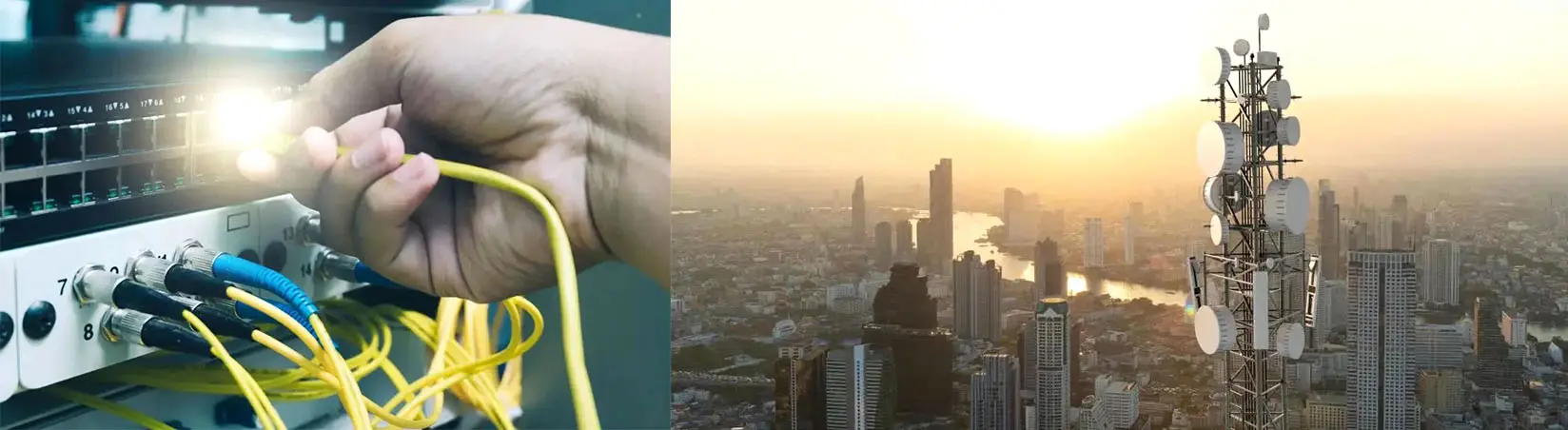
The current answer is: use a parallel port breakout and subminiature connector (VSFFC). The so-called port branch refers to the use of high-speed transceiver ports in the Base-8 system based on 8-core optical fibers to achieve parallel optical fiber transmission at a speed of 800G (for example only). But this is not achieved with single port transport, instead this requires 4 200G ports in a spine-leaf architecture, or 400G ports in a leaf-server architecture, which are then split and used as 8 50G ports run. In this way, a high-speed port can be broken up into multiple ports without the transfer rate of each port being too high.
This solution not only meets the bandwidth requirements, but also reduces energy consumption, and the cooling time is shorter than that required by 800G. But for most data center operators, 800G transmission speeds are still a long way off. In addition, this solution is also suitable for 40G, 100G or 400G transmission speeds in current mainstream hyperscale/cloud data centers. Taking a 100G duplex transceiver as an example, its power consumption for a QSFP-DD module is about 4.5 watts. In contrast, a 400G parallel fiber optic transceiver operating in split mode with four 100G ports consumes only 3 watts per port. Disregarding the power consumption and space of air conditioning and switch chassis, this can save up to 30% of electricity.
Achieving sustainable management of the data center and reducing downtime for network upgrades or expansions go hand in hand.
Port branching has another advantage: If an upgrade is required in the future, data center operators can upgrade to higher transmission speeds with only minor changes in the passive network infrastructure, without changing technology or completely replacing cabling components . It can be said that achieving sustainable management of data centers and reducing downtime for network upgrades or expansions go hand in hand.
With the introduction of 400G and future 800G transceivers, we will also add additional connector interfaces to the traditional LC duplex and MPO-12 cabling interfaces, such as the new MPO-16 and MPO-12 DD (double row ) interface, and subminiature connector SN, CS and MDC interfaces.
A single LC duplex connector can accommodate up to three MDC or SN connector interfaces, which triples the density and reduces the total cost of ownership. In addition, MDC and SN connectors offer the possibility of direct port branching at the transceiver level for point-to-point wiring.
Helping data center intensification to reduce space and cost
Data centers can be intensified to reduce space requirements, reduce costs, and achieve high-speed transmission through the use of modern transceivers.
The current answer is: use a parallel port breakout and subminiature connector (VSFFC). The so-called port branch refers to the use of high-speed transceiver ports in the Base-8 system based on 8-core optical fibers to achieve parallel optical fiber transmission at a speed of 800G (for example only). But this is not achieved with single port transport, instead this requires 4 200G ports in a spine-leaf architecture, or 400G ports in a leaf-server architecture, which are then split and used as 8 50G ports run. In this way, a high-speed port can be broken up into multiple ports without the transfer rate of each port being too high.
This solution not only meets the bandwidth requirements, but also reduces energy consumption, and the cooling time is shorter than that required by 800G. But for most data center operators, 800G transmission speeds are still a long way off. In addition, this solution is also suitable for 40G, 100G or 400G transmission speeds in current mainstream hyperscale/cloud data centers. Taking a 100G duplex transceiver as an example, its power consumption for a QSFP-DD module is about 4.5 watts. In contrast, a 400G parallel fiber optic transceiver operating in split mode with four 100G ports consumes only 3 watts per port. Disregarding the power consumption and space of air conditioning and switch chassis, this can save up to 30% of electricity.
Achieving sustainable management of the data center and reducing downtime for network upgrades or expansions go hand in hand.
Port branching has another advantage: If an upgrade is required in the future, data center operators can upgrade to higher transmission speeds with only minor changes in the passive network infrastructure, without changing technology or completely replacing cabling components . It can be said that achieving sustainable management of data centers and reducing downtime for network upgrades or expansions go hand in hand.
With the introduction of 400G and future 800G transceivers, we will also add additional connector interfaces to the traditional LC duplex and MPO-12 cabling interfaces, such as the new MPO-16 and MPO-12 DD (double row ) interface, and subminiature connector SN, CS and MDC interfaces.
A single LC duplex connector can accommodate up to three MDC or SN connector interfaces, which triples the density and reduces the total cost of ownership. In addition, MDC and SN connectors offer the possibility of direct port branching at the transceiver level for point-to-point wiring.
Related News
Read More >>
 AI Data Center Optical Evolution: Trends & Market
Sep .20.2026
With the rapid growth of artificial intelligence computing, data centers now need much more bandwidth. The physical limitations of traditional copper cable connections are becoming increasingly apparent as transmission speeds rise.
 The Global OCS Market Will Exceed $8 Billion by 2030
Sep .09.2026
The latest industry forecasts indicate that by 2030, the total size of the global optical path switch market is expected to exceed $8 billion, with a compound annual growth rate (CAGR) of over 30% between 2026 and 2030.
 400G Single-Lane: Next Inflection for AI Datacenters
Aug .27.2026
400G per lane is the next inflection for AI data centers, boosting bandwidth and scaling, but requires advances in materials, packaging, and cooling.
 AI-driven 800G Ramp-up Amplifies Quality Risks
Aug .14.2026
Faced with a surge in orders, leading global manufacturers are increasing production line speeds and shortening delivery cycles. However, the real challenge of this growth goes beyond “can we deliver orders on time?”