


Industry News
A domestic technical research institute released the industry's first high-power, anti-reflection laser
Views : 938
Author : JIUZHOU
Update time : 2022-12-16 11:52:40
A technology research institute released the industry's first high-power, anti-reflection laser, which can achieve more advantageous transmission performance in small-size pluggable external light source modules and photoelectric co-packaging (CPO), and provide continuous light source (CW).
ICC News Recently, a technology research institute launched the latest research results - the industry's first high-power, anti-reflection laser. This laser breaks through the dependence of traditional lasers on isolators, and can achieve more advantageous transmission performance in small-size pluggable external light source modules (External Laser Small Form Factor Pluggable, referred to as ELSFP) and photoelectric co-package (CPO), and Continuous light source (CW) is provided. The relevant papers and results of this new laser will be published in OFC 2023 in detail.
The first new laser structure, abandoning the isolator, simplifying the package and reducing the cost
High-power semiconductor lasers are widely used as an indispensable monochromatic light source in the fields of communication, laser radar, and sensing. However, due to their own positive feedback amplification process, traditional lasers are particularly sensitive to reflections, even -20dB reflections Getting into the laser also causes coherence collapse. This problem has plagued the industry for the past three decades, so in practical applications, most semiconductor lasers require isolators to work stably.
A technology research institute optimized the design based on the physical mechanism of optical-electrical interaction, and adopted an innovative laser structure to design the industry's first high-power, anti-reflection laser with an output power of 100mW. Under the same reflection conditions, Its relative intensity noise is at least two orders of magnitude lower than that of conventional lasers, making this high-power laser work stably without an isolator. From a cost point of view, since the cost of the isolator is comparable to that of the laser, abandoning the isolator will directly reduce the cost by half.
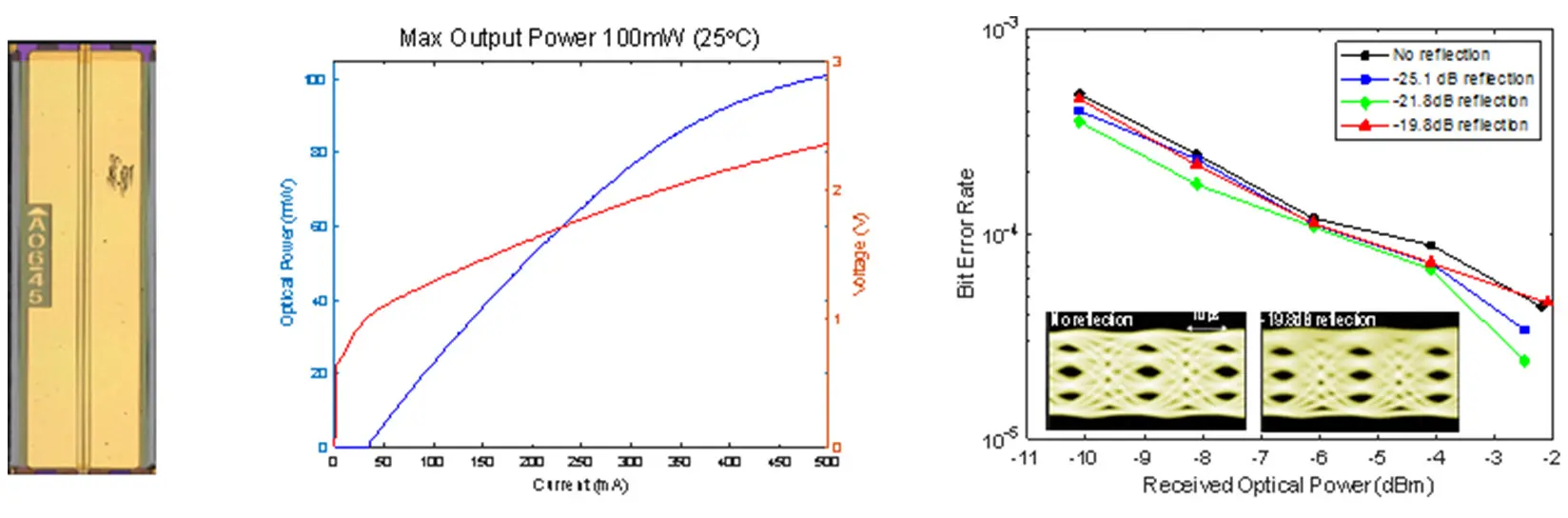
Left picture/high-power, anti-reflection laser chip; middle picture/LIV curve of the laser; right picture/100G transmission performance under reflection
Help silicon photonics and CPO layout, create more market possibilities
The high-power laser released this time adopts a special waveguide design, which improves the coupling efficiency of the laser and the fiber, and at the same time avoids the differential loss caused by the isolation area, making this high-power laser suitable for use in ELSFP modules, silicon photonics and optoelectronic co-packaging more advantageous. The test results show that this laser can fully meet the requirements of IEEE 802.3 without an isolator; the 100G transmission system using this laser as a light source has no degradation in transmission performance under reflection conditions.
The application of this laser may greatly reduce the purchase and production costs of the optical module business. Relying on its own advantages in silicon photonics technology and this new type of laser, it is expected to provide customers with more competitive optical module products. More importantly, this high degree of innovation has built a very high technical threshold, which has once again strengthened its technological leadership in the industry. At the same time, the laser is also applicable to fields such as lidar and sensing, and will accelerate the exploration of new tracks.
ICC News Recently, a technology research institute launched the latest research results - the industry's first high-power, anti-reflection laser. This laser breaks through the dependence of traditional lasers on isolators, and can achieve more advantageous transmission performance in small-size pluggable external light source modules (External Laser Small Form Factor Pluggable, referred to as ELSFP) and photoelectric co-package (CPO), and Continuous light source (CW) is provided. The relevant papers and results of this new laser will be published in OFC 2023 in detail.
The first new laser structure, abandoning the isolator, simplifying the package and reducing the cost
High-power semiconductor lasers are widely used as an indispensable monochromatic light source in the fields of communication, laser radar, and sensing. However, due to their own positive feedback amplification process, traditional lasers are particularly sensitive to reflections, even -20dB reflections Getting into the laser also causes coherence collapse. This problem has plagued the industry for the past three decades, so in practical applications, most semiconductor lasers require isolators to work stably.
A technology research institute optimized the design based on the physical mechanism of optical-electrical interaction, and adopted an innovative laser structure to design the industry's first high-power, anti-reflection laser with an output power of 100mW. Under the same reflection conditions, Its relative intensity noise is at least two orders of magnitude lower than that of conventional lasers, making this high-power laser work stably without an isolator. From a cost point of view, since the cost of the isolator is comparable to that of the laser, abandoning the isolator will directly reduce the cost by half.
Left picture/high-power, anti-reflection laser chip; middle picture/LIV curve of the laser; right picture/100G transmission performance under reflection
Help silicon photonics and CPO layout, create more market possibilities
The high-power laser released this time adopts a special waveguide design, which improves the coupling efficiency of the laser and the fiber, and at the same time avoids the differential loss caused by the isolation area, making this high-power laser suitable for use in ELSFP modules, silicon photonics and optoelectronic co-packaging more advantageous. The test results show that this laser can fully meet the requirements of IEEE 802.3 without an isolator; the 100G transmission system using this laser as a light source has no degradation in transmission performance under reflection conditions.
The application of this laser may greatly reduce the purchase and production costs of the optical module business. Relying on its own advantages in silicon photonics technology and this new type of laser, it is expected to provide customers with more competitive optical module products. More importantly, this high degree of innovation has built a very high technical threshold, which has once again strengthened its technological leadership in the industry. At the same time, the laser is also applicable to fields such as lidar and sensing, and will accelerate the exploration of new tracks.
Related News
Read More >>
 AI Data Center Optical Evolution: Trends & Market
Sep .20.2026
With the rapid growth of artificial intelligence computing, data centers now need much more bandwidth. The physical limitations of traditional copper cable connections are becoming increasingly apparent as transmission speeds rise.
 The Global OCS Market Will Exceed $8 Billion by 2030
Sep .09.2026
The latest industry forecasts indicate that by 2030, the total size of the global optical path switch market is expected to exceed $8 billion, with a compound annual growth rate (CAGR) of over 30% between 2026 and 2030.
 400G Single-Lane: Next Inflection for AI Datacenters
Aug .27.2026
400G per lane is the next inflection for AI data centers, boosting bandwidth and scaling, but requires advances in materials, packaging, and cooling.
 AI-driven 800G Ramp-up Amplifies Quality Risks
Aug .14.2026
Faced with a surge in orders, leading global manufacturers are increasing production line speeds and shortening delivery cycles. However, the real challenge of this growth goes beyond “can we deliver orders on time?”