


Industry News
An electronic technology company's CWDM coarse wavelength division multiplexer shipped more than 1 million channels
Views : 609
Author : JIUZHOU
Update time : 2023-05-19 11:14:18
The CWDM coarse wavelength division multiplexer of a certain electronic technology company has shipped more than 1 million channels. This product adopts the CCWDM technology platform and has a more compact size and better insertion loss.
At the same time, intelligent automated production helps the monthly standard production capacity of CWDM devices to reach more than 300,000 channels.
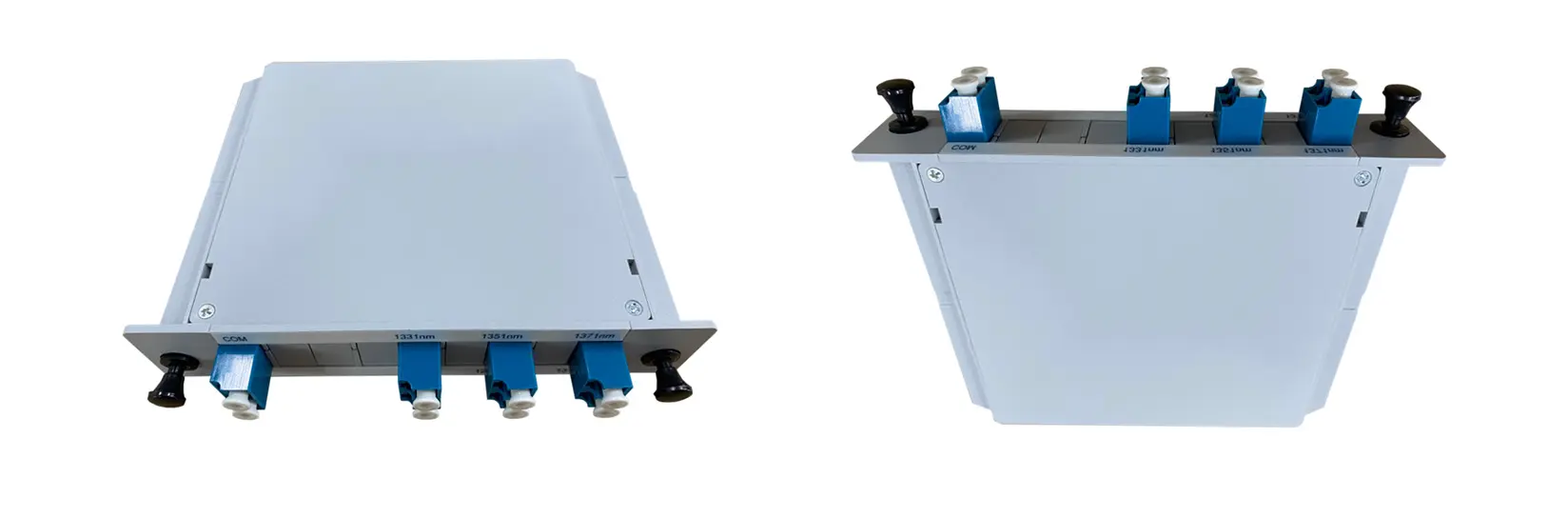
An Electronic Technology Co., Ltd. announced that CWDM coarse wavelength division multiplexers have shipped more than 1 million channels. The company's CWDM products adopt the CCWDM technology platform to achieve more compact size and better insertion loss.
It will be applied to the 5G fronthaul market in batches from 2021, and quickly become a major supplier in the CWDM market, with a total of more than 1 million channels shipped so far.
The company's CWDM coarse wavelength division multiplexer has excellent high reliability. According to the feedback data from customers in the market, the failure rate is less than 100ppm. The market requirement for such products is generally 1000ppm.
The excellent quality comes from the company's continuous investment in intelligent automation and process optimization in CWDM production.
At present, the company has realized the intelligent automation of the whole process of chip placement, coupling, dispensing, UV, testing and other device processes, and 100% automation of key processes such as chip placement and coupling curing.
The improvement of the level of intelligent automation has also brought about a leap in production efficiency. The production capacity of CWDM devices of an electronic technology company has reached a new level, and has broken through to more than 250 channels in 8 hours per person and one shift.
The monthly standard production capacity of WDM devices of an electronic technology company has reached more than 300,000 channels.
Carry dreams with light and build light with cores. An Electronic Technology Co., Ltd. is one of the top ten enterprises with comprehensive competitiveness in China's optical communication industry.
In recent years, a full range of TFF thin-film filters have been commercialized. VCSEL, DFB and EML lasers are about to be mass-produced, and xWDM and AWG passive wavelength division and optical module products.
It has a relatively high share in the 5G and WDM optical transmission markets. The industrial layout of chip-device-module-subsystem has been completed. In the future, it will continue to polish its own technology and continuously improve its core competitiveness.
At the same time, intelligent automated production helps the monthly standard production capacity of CWDM devices to reach more than 300,000 channels.
An Electronic Technology Co., Ltd. announced that CWDM coarse wavelength division multiplexers have shipped more than 1 million channels. The company's CWDM products adopt the CCWDM technology platform to achieve more compact size and better insertion loss.
It will be applied to the 5G fronthaul market in batches from 2021, and quickly become a major supplier in the CWDM market, with a total of more than 1 million channels shipped so far.
The company's CWDM coarse wavelength division multiplexer has excellent high reliability. According to the feedback data from customers in the market, the failure rate is less than 100ppm. The market requirement for such products is generally 1000ppm.
The excellent quality comes from the company's continuous investment in intelligent automation and process optimization in CWDM production.
At present, the company has realized the intelligent automation of the whole process of chip placement, coupling, dispensing, UV, testing and other device processes, and 100% automation of key processes such as chip placement and coupling curing.
The improvement of the level of intelligent automation has also brought about a leap in production efficiency. The production capacity of CWDM devices of an electronic technology company has reached a new level, and has broken through to more than 250 channels in 8 hours per person and one shift.
The monthly standard production capacity of WDM devices of an electronic technology company has reached more than 300,000 channels.
Carry dreams with light and build light with cores. An Electronic Technology Co., Ltd. is one of the top ten enterprises with comprehensive competitiveness in China's optical communication industry.
In recent years, a full range of TFF thin-film filters have been commercialized. VCSEL, DFB and EML lasers are about to be mass-produced, and xWDM and AWG passive wavelength division and optical module products.
It has a relatively high share in the 5G and WDM optical transmission markets. The industrial layout of chip-device-module-subsystem has been completed. In the future, it will continue to polish its own technology and continuously improve its core competitiveness.
Related News
Read More >>
 Optical Connectivity: The Engine of AI Scaling
May .08.2026
With the rapid growth of generative AI and large language models, data centers are quickly becoming intelligent computing centers. The growing demand for computing power from AI models is not just about performance.
 5G Core & MEC: AI-Driven Growth Through 2030
Apr .17.2026
Global communications infrastructure is currently witnessing a long-awaited "second wave of explosive growth."
 6G Outlook: The Future of Next-Gen Wireless Communication
Apr .03.2026
The transition from 5G to 6G is more than just faster internet speeds. 6G will bring new changes to network design, operation, and business models. Wireless communication will become smarter, more efficient, and more energy-efficient.
 Ready or Not, Next-Gen Communication Is Here
Mar .20.2026
Standardization efforts for the next generation of mobile communication technologies commenced in 2025. They project commercial deployment to take place around 2030.