


Industry News
50G PON application prospect
Views : 1182
Author : JIUZHOU
Update time : 2022-09-09 10:32:03
The bandwidth of the next-generation PON optical access network is increased to 50Gbps, and the 50G PON with a single-channel rate of 50Gbps will usher in development.

With the gradual construction and popularization of gigabit optical networks, the deployment of gigabit optical access networks based on 10G PON technology has accelerated. 10G PON network has the characteristics of higher bandwidth, converged coexistence, smooth upgrade, etc., and has the ability to continuously evolve to the next generation of PON. In the layout of the next-generation PON technology, the industry has generally recognized that the bandwidth of the next-generation optical access network will be increased to 50Gbps. ITU/FSAN has formed the technical requirements for next-generation PONs, taking into account the needs of home users, enterprise users, and mobile front haul/backhaul scenarios, focusing on 50G PON technology with a single-channel rate of 50Gbps.
50G PON technical standard progress
In 2018, ITU/FSAN started the formulation of the single-wavelength 50G PON standard, named G.HSP (G.Higher Speed PON).
In 2019, the general requirement of 50G PON G.9804.1 was released, which clarified the single-wavelength TDM PON architecture and the combination of uplink and down link rates. In addition, 50G PON needs to meet the coexistence and smooth evolution of 10G PON and stock ODN.
In 2021, the ITU-T 50G PON series of standards will be officially released. The series of standards include: the general requirements standard revision G.9804.1 Amd1, the general protocol layer standard G.9804.2, and the physical layer standard G.9804.3. This marks that 50G PON has completed the standardization of basic functions, laying a foundation for the next step of product development and solution verification.
50G PON technical features
50G PON adopts single-fiber bidirectional transmission, down link TDM time division multiplexing, and uplink TDMA time division multiple access to realize point-to-multipoint communication between OLT and ONU. Its key technologies include wavelength selection, line coding, line rate, FEC error correction technology, Common TC (Transmission Convergence) technology, and PHY layer devices. Compared with 10G PON, the 50G PON standard provides more than 4 times the access bandwidth, better service support capabilities (large bandwidth, low latency, low jitter), network protection/security, and supports the coexistence and smooth evolution of 10G PON, and Compatible with existing ODN networks as much as possible.
line rate
ITU-T has clarified the rate requirements of 50G-PON, which supports symmetric and asymmetric combinations of different rates; 1 rate for the down link and 4 line rates for the uplink rate.
FEC error correction technology
After the 50G PON line rate increases, the receiver sensitivity decreases, and the transceiver performance needs to be improved to reuse the ODN network that has been deployed in large numbers. In order to reduce the index requirements of high-speed optical devices, 50G PON introduces the LDPC (Low Density Parity Check, Low Density Parity Check) codec scheme for FEC forward error correction.
Common TC technology
In order to better support low latency, 50G PON mainly achieves low latency by means of dedicated activation wavelength (DAW), CoDBA, and reducing the allocation period. The dedicated activated wavelength technology avoids opening the quiet window on the upstream wavelength of 50G PON, and cancels the delay caused by the quiet window; CoDBA cooperates with DBA, and the OLT learns the upstream service transmission requirements of the ONU through the upper-layer equipment, and allocates bandwidth to On the ONU, the buffering time of service data in the ONU is minimized; each T-CONT can be configured with multiple burst frames within a 125μs period, reducing the time interval for the ONU to obtain bandwidth allocation, thereby reducing the buffering time of service data in the ONU.
PHY layer device
50G PON PHY layer devices mainly include key optoelectronics devices such as optical transmitting components, optical receiving components, laser driver LDD, burst TIA and clock recovery chip CDR. The OLT light emitting device can use EML (Electro-absorption Modulated Laser), integrated SOA (Semiconductor Optical Amplifier) EML device, etc. The optical receiving device can use APD (Avalanche Photodiode), integrated SOA PIN device, ONU driver needs to support burst function, Receive does not require burst clock recovery BCDR, OLT receive requires burst mode clock recovery. The transmission damage to high-speed optical signal needs to be compensated and restored by a dedicated DSP.
50G PON application scenarios
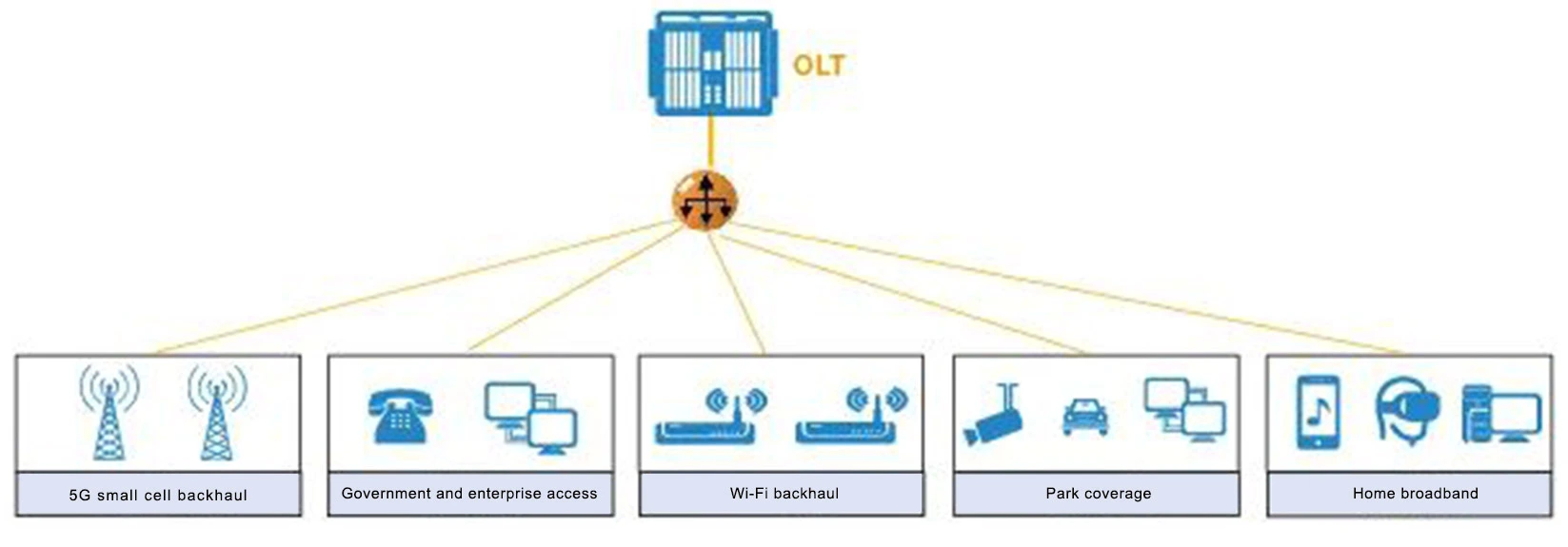
50G PON is a comprehensive improvement of access network capabilities, realizing a comprehensive improvement in large bandwidth, low latency guarantee and channelization capabilities. It is a new type of access base with differentiated bearing capabilities for multiple application scenarios (see Figure 1).
Home ultra-high broadband service access
The traffic of home services continues to grow, and users are increasingly pursuing service experience, which puts forward higher requirements for the bandwidth and latency of broadband service access; cloud VR, cloud office, online games, online education, and smart home services are emerging one after another. Cloud VR/Games, pursuing immersive service experience, are typical large-bandwidth (200Mbps~4Gbps) and low-latency (10~5ms) services. The various low-latency solutions proposed by 50G PON can meet the needs of such services. need.
High-quality enterprise/park information construction
50G PON can provide access bandwidth close to 50Gbps, and can be widely used in enterprise private line access, campus network/campus network informatization construction, and one optical fiber and one network can meet all business access needs. 50G PON has enhanced low-latency and channelized guarantee capabilities, which can provide low-latency and deterministic access network capabilities for enterprises and industrial intelligence fields, and help enterprises to transform into informatization.
A New Choice for Mobile Bearer/Wi-Fi Backhaul
50G PON mobile bearer (base station backhaul, midhaul) has advantages in power consumption, size, and cost, and can achieve 100μs delay, meeting the technical requirements of mobile backhaul networks. With the popularity of Wi-Fi 6, Wi-Fi networks have rapidly evolved from 100M to gigabit coverage, and the new generation of Wi-Fi 7 will soon enter commercial use, further improving bandwidth and performance. The rapid development of Wi-Fi networks also puts forward higher requirements for the backhaul access of Wi-Fi networks. The large bandwidth of 50G PON can provide a symmetrical bandwidth close to 50Gbps, which meets the needs of high-speed backhaul of Wi-Fi networks.
With the release of the 50G PON series of standards, related key technologies and industry chains are gradually maturing. ZTE will release the industry's first ONU prototype supporting 50G PON and Wi-Fi 7 in 2022. In the future, under the background of the country's vigorous promotion of new infrastructure for the digital economy, 50G PON will be widely used in all business scenarios and become a new base for the digital economy.
With the gradual construction and popularization of gigabit optical networks, the deployment of gigabit optical access networks based on 10G PON technology has accelerated. 10G PON network has the characteristics of higher bandwidth, converged coexistence, smooth upgrade, etc., and has the ability to continuously evolve to the next generation of PON. In the layout of the next-generation PON technology, the industry has generally recognized that the bandwidth of the next-generation optical access network will be increased to 50Gbps. ITU/FSAN has formed the technical requirements for next-generation PONs, taking into account the needs of home users, enterprise users, and mobile front haul/backhaul scenarios, focusing on 50G PON technology with a single-channel rate of 50Gbps.
50G PON technical standard progress
In 2018, ITU/FSAN started the formulation of the single-wavelength 50G PON standard, named G.HSP (G.Higher Speed PON).
In 2019, the general requirement of 50G PON G.9804.1 was released, which clarified the single-wavelength TDM PON architecture and the combination of uplink and down link rates. In addition, 50G PON needs to meet the coexistence and smooth evolution of 10G PON and stock ODN.
In 2021, the ITU-T 50G PON series of standards will be officially released. The series of standards include: the general requirements standard revision G.9804.1 Amd1, the general protocol layer standard G.9804.2, and the physical layer standard G.9804.3. This marks that 50G PON has completed the standardization of basic functions, laying a foundation for the next step of product development and solution verification.
50G PON technical features
50G PON adopts single-fiber bidirectional transmission, down link TDM time division multiplexing, and uplink TDMA time division multiple access to realize point-to-multipoint communication between OLT and ONU. Its key technologies include wavelength selection, line coding, line rate, FEC error correction technology, Common TC (Transmission Convergence) technology, and PHY layer devices. Compared with 10G PON, the 50G PON standard provides more than 4 times the access bandwidth, better service support capabilities (large bandwidth, low latency, low jitter), network protection/security, and supports the coexistence and smooth evolution of 10G PON, and Compatible with existing ODN networks as much as possible.
line rate
ITU-T has clarified the rate requirements of 50G-PON, which supports symmetric and asymmetric combinations of different rates; 1 rate for the down link and 4 line rates for the uplink rate.
FEC error correction technology
After the 50G PON line rate increases, the receiver sensitivity decreases, and the transceiver performance needs to be improved to reuse the ODN network that has been deployed in large numbers. In order to reduce the index requirements of high-speed optical devices, 50G PON introduces the LDPC (Low Density Parity Check, Low Density Parity Check) codec scheme for FEC forward error correction.
Common TC technology
In order to better support low latency, 50G PON mainly achieves low latency by means of dedicated activation wavelength (DAW), CoDBA, and reducing the allocation period. The dedicated activated wavelength technology avoids opening the quiet window on the upstream wavelength of 50G PON, and cancels the delay caused by the quiet window; CoDBA cooperates with DBA, and the OLT learns the upstream service transmission requirements of the ONU through the upper-layer equipment, and allocates bandwidth to On the ONU, the buffering time of service data in the ONU is minimized; each T-CONT can be configured with multiple burst frames within a 125μs period, reducing the time interval for the ONU to obtain bandwidth allocation, thereby reducing the buffering time of service data in the ONU.
PHY layer device
50G PON PHY layer devices mainly include key optoelectronics devices such as optical transmitting components, optical receiving components, laser driver LDD, burst TIA and clock recovery chip CDR. The OLT light emitting device can use EML (Electro-absorption Modulated Laser), integrated SOA (Semiconductor Optical Amplifier) EML device, etc. The optical receiving device can use APD (Avalanche Photodiode), integrated SOA PIN device, ONU driver needs to support burst function, Receive does not require burst clock recovery BCDR, OLT receive requires burst mode clock recovery. The transmission damage to high-speed optical signal needs to be compensated and restored by a dedicated DSP.
50G PON application scenarios
50G PON is a comprehensive improvement of access network capabilities, realizing a comprehensive improvement in large bandwidth, low latency guarantee and channelization capabilities. It is a new type of access base with differentiated bearing capabilities for multiple application scenarios (see Figure 1).
Home ultra-high broadband service access
The traffic of home services continues to grow, and users are increasingly pursuing service experience, which puts forward higher requirements for the bandwidth and latency of broadband service access; cloud VR, cloud office, online games, online education, and smart home services are emerging one after another. Cloud VR/Games, pursuing immersive service experience, are typical large-bandwidth (200Mbps~4Gbps) and low-latency (10~5ms) services. The various low-latency solutions proposed by 50G PON can meet the needs of such services. need.
High-quality enterprise/park information construction
50G PON can provide access bandwidth close to 50Gbps, and can be widely used in enterprise private line access, campus network/campus network informatization construction, and one optical fiber and one network can meet all business access needs. 50G PON has enhanced low-latency and channelized guarantee capabilities, which can provide low-latency and deterministic access network capabilities for enterprises and industrial intelligence fields, and help enterprises to transform into informatization.
A New Choice for Mobile Bearer/Wi-Fi Backhaul
50G PON mobile bearer (base station backhaul, midhaul) has advantages in power consumption, size, and cost, and can achieve 100μs delay, meeting the technical requirements of mobile backhaul networks. With the popularity of Wi-Fi 6, Wi-Fi networks have rapidly evolved from 100M to gigabit coverage, and the new generation of Wi-Fi 7 will soon enter commercial use, further improving bandwidth and performance. The rapid development of Wi-Fi networks also puts forward higher requirements for the backhaul access of Wi-Fi networks. The large bandwidth of 50G PON can provide a symmetrical bandwidth close to 50Gbps, which meets the needs of high-speed backhaul of Wi-Fi networks.
With the release of the 50G PON series of standards, related key technologies and industry chains are gradually maturing. ZTE will release the industry's first ONU prototype supporting 50G PON and Wi-Fi 7 in 2022. In the future, under the background of the country's vigorous promotion of new infrastructure for the digital economy, 50G PON will be widely used in all business scenarios and become a new base for the digital economy.
Related News
Read More >>
 AI Data Center Optical Evolution: Trends & Market
Sep .20.2026
With the rapid growth of artificial intelligence computing, data centers now need much more bandwidth. The physical limitations of traditional copper cable connections are becoming increasingly apparent as transmission speeds rise.
 The Global OCS Market Will Exceed $8 Billion by 2030
Sep .09.2026
The latest industry forecasts indicate that by 2030, the total size of the global optical path switch market is expected to exceed $8 billion, with a compound annual growth rate (CAGR) of over 30% between 2026 and 2030.
 400G Single-Lane: Next Inflection for AI Datacenters
Aug .27.2026
400G per lane is the next inflection for AI data centers, boosting bandwidth and scaling, but requires advances in materials, packaging, and cooling.
 AI-driven 800G Ramp-up Amplifies Quality Risks
Aug .14.2026
Faced with a surge in orders, leading global manufacturers are increasing production line speeds and shortening delivery cycles. However, the real challenge of this growth goes beyond “can we deliver orders on time?”