


Industry News
What are the advantages of EXFO's advanced end-to-end high-speed solutions for testing next-generation Ethernet?
Views : 796
Author : JIUZHOU
Update time : 2022-09-16 11:24:44
Checklist of 400G/800G Testing Challenges in Lab and Manufacturing Environments

● Support Quality of Service (QoS) testing for 400G Ethernet opening and troubleshooting
○ According to the standard, test the high-speed transfer rate
● Support for optical modules of various types and rates, no need to add testers
○ The test instrument can be flexibly adapted to new pluggable optical modules to meet the needs of future upgrades
● Provide interfaces based on NRZ and PAM4 to support comprehensive testing and analysis capabilities
○ Support the latest coherent optical modules, such as ZR, ZR+, CFP2-DCO
● Support Quality of Service (QoS) testing for 400G Ethernet opening and troubleshooting
400G Test Solutions
As defined by the IEEE 802.3bs standard, 400GE is currently the highest client rate in the Ethernet ecosystem and can provide greater functionality for critical aggregation and high-bandwidth interconnect applications. These applications cover a wide range of: cloud data centers, Internet exchanges, hosting services, wireless infrastructure, carrier networks, and video distribution infrastructure.
EXFO's 400G test and measurement solutions are advanced, powerful, versatile and scalable, enabling the integration of rack mount (LTB-8/LTB-2) and portable (FTB-4 Pro/FTB-2 Pro) platforms with various These modules are combined for unique flexibility.
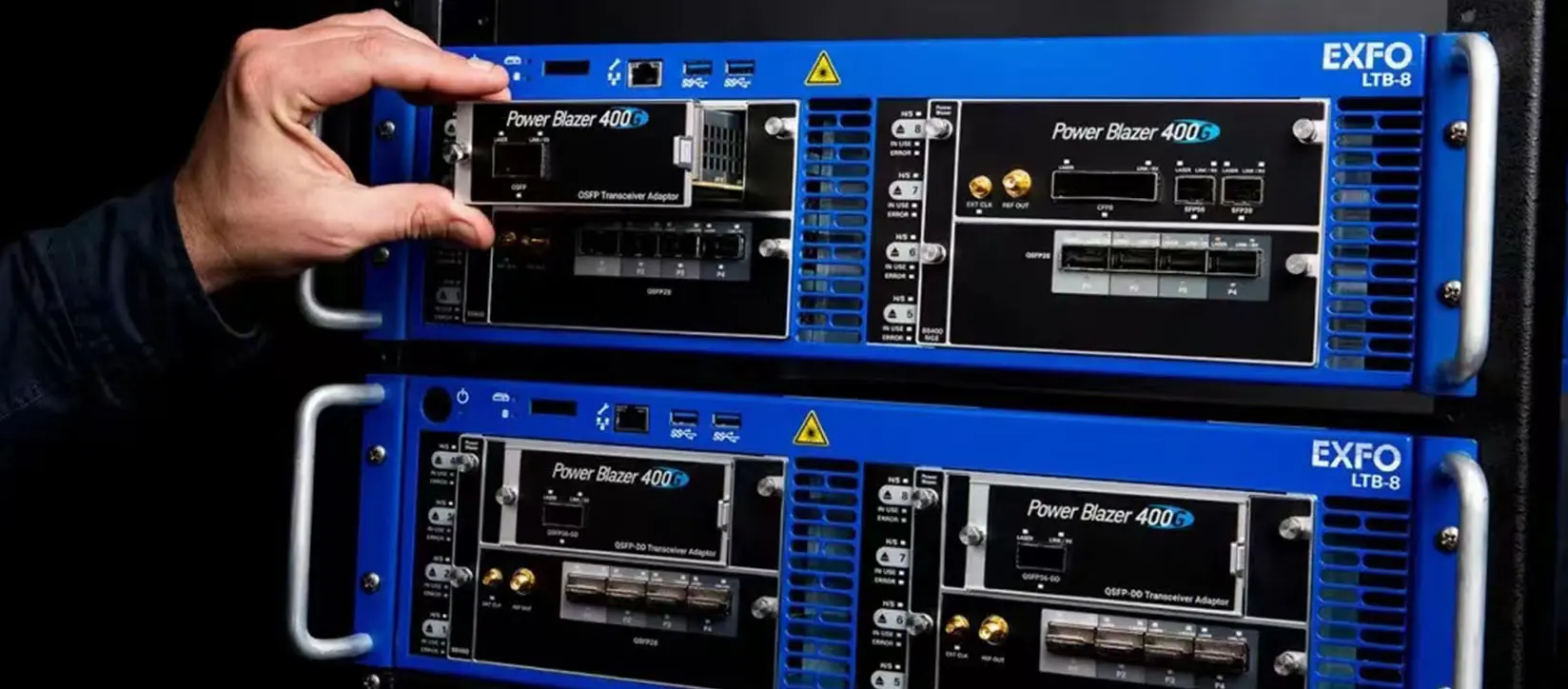
The new 400G technology defines new physical layer specifications for 200 Gbit/s and 400 Gbit/s transmissions and specifies that Forward Error Correction (FEC) is mandatory to correct errors, designed to compensate for signal loss and optimize the link quality. EXFO's high-speed tester has FEC statistical tools based on Reed-Salomon coding, also known as RS (544, 514), the code word consists of 544 symbols, of which 514 symbols are dedicated to the payload and 30 symbols are used for on parity check. This type of FEC can correct up to 15 erroneous symbols per code word.
PAM4: the key technology to realize 400G transmission
The latest 400G rates are achieved in high-speed interfaces thanks to the use of 4-level Pulse Amplitude Modulation (PAM4), which essentially doubles the data density relative to NRZ. As a new encoding technology, PAM4 can drive 8 50G channels or 4 100G channels for different versions of CFP8, OSFP and QSFP-DD modules, replacing traditional NRZ-based interfaces. In this architecture, PAM4-based devices can bring many advantages, but also bring great challenges to testing, because analyzing the capacity of a 4-level system is much more complicated than analyzing the capacity of NRZ. In addition, the amplitude of PAM4 is three times shorter than that of NRZ, the signal-to-noise ratio is lower, and the coding level spacing is smaller, so it is more sensitive to noise.
Therefore, interface analysis and debugging based on 400G PAM4 is very complicated, because several parameters of the transceiver, such as Tx and Rx optical power, power consumption, temperature, delay, have to be tested before, during and after the installation of the network Poor wait.
EXFO provides a range of tools to analyze and debug PAM4-based transceivers, such as pre-emphasis, equalization, and PAM4 histogram (4 levels for representing modulation, enabling real-time PAM4 analysis per channel).
Validating transceivers in a manufacturing environment
Today, the new generation of 200G/400G transceivers are in mass production at thousands of units per day, and they must meet stringent quality and reliability standards to work reliably in today's demanding high-speed networks, including 5G networks . Manufacturers need simple solutions that provide fast and accurate transceiver evaluation and verification at different stages of production to maintain this production speed.
It is to meet this need that we have designed a unique end-to-end solution for qualifying next-generation transceivers, including client-side testers, and a suite of analysis tools to quickly and easily validate 200G/400G optical interface.
800G high-speed solution
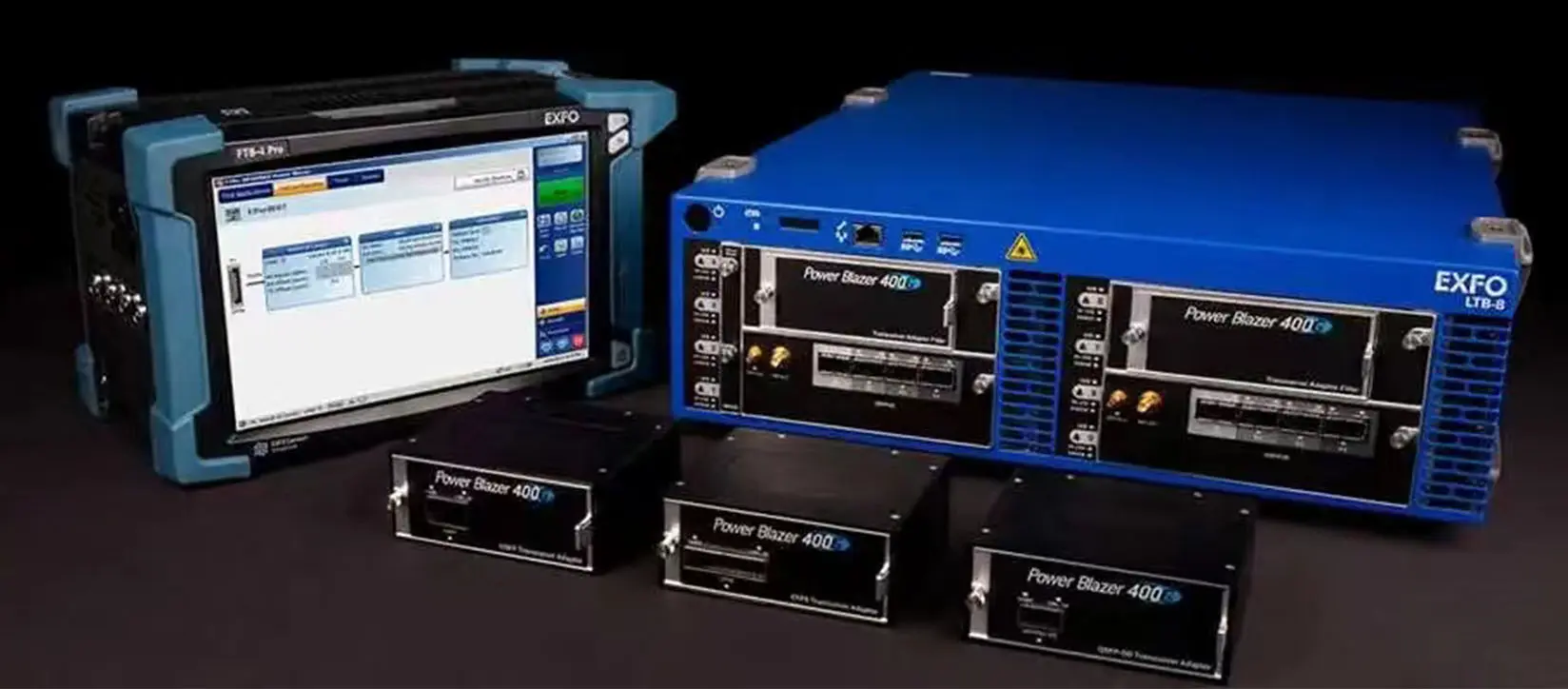
For 400G dual-port testing, EXFO's modular, scalable platform is recommended, ideal for laboratory and manufacturing environments.
Main advantage
Compliant with 400G ecosystem requirements
EXFO's high-speed solutions meet 400G ecosystem requirements, support current 200G/400G optical interfaces for Ethernet testing, use FlexE technology to support flexible Ethernet rate transmission, and use FlexO/OTUCn to build on existing OTN technology Transmit greater client bandwidth.
Secure long-term investment
Designed with an Open Transceiver System (OTS), you can ensure that your test equipment can meet the test requirements of next-generation transceivers. Simply plug in and test specific types of transceivers, including those used in 200G/400G systems, such as QSFP-DD, OSFP, and CFP8, without replacing the entire test module.
Fully compatible with various optical test equipment
Our rack-mountable platforms can simultaneously install optical testers (switches, power meters, light sources, spectrum analyzers, OTDRs) and transmission and data solutions from 1G to 400G.
Remote Control
More and more people are starting to work from home, which is a general trend. The Windows-based design gives EXFO's 400G solution the flexibility to perform tests and evaluations remotely using third-party remote desktop software.
Automation
Given the challenges operators and network equipment manufacturers are facing to reduce operational costs, it is tempting to use automation to manage complex tasks. In EXFO's optical and transmission and data solutions, remote control is also possible using the extended SCPI command library or using API examples.
Main application
200G/400G Ethernet: Generate and test traffic according to IEEE 802.3bs
High-speed transceiver verification (optical, electrical testing)
Support DAC and AOC
Bit error test
FlexE test function, supports low-speed and high-speed Ethernet clients
OTUCn/FlexO
RFC 2544
Forward Error Correction (FEC) Testing: Error Insertion and Monitoring
400G/800G test products for lab and manufacturing environments
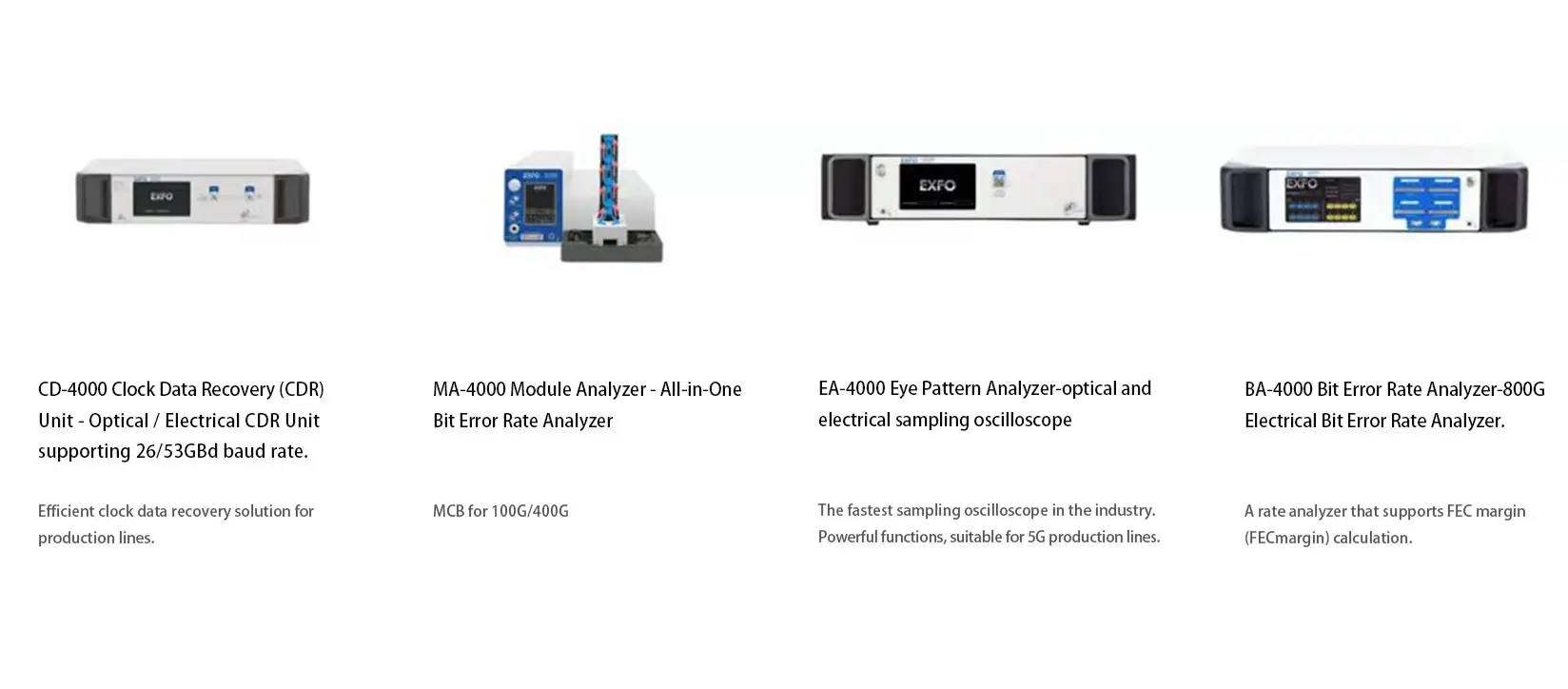
● Support Quality of Service (QoS) testing for 400G Ethernet opening and troubleshooting
○ According to the standard, test the high-speed transfer rate
● Support for optical modules of various types and rates, no need to add testers
○ The test instrument can be flexibly adapted to new pluggable optical modules to meet the needs of future upgrades
● Provide interfaces based on NRZ and PAM4 to support comprehensive testing and analysis capabilities
○ Support the latest coherent optical modules, such as ZR, ZR+, CFP2-DCO
● Support Quality of Service (QoS) testing for 400G Ethernet opening and troubleshooting
400G Test Solutions
As defined by the IEEE 802.3bs standard, 400GE is currently the highest client rate in the Ethernet ecosystem and can provide greater functionality for critical aggregation and high-bandwidth interconnect applications. These applications cover a wide range of: cloud data centers, Internet exchanges, hosting services, wireless infrastructure, carrier networks, and video distribution infrastructure.
EXFO's 400G test and measurement solutions are advanced, powerful, versatile and scalable, enabling the integration of rack mount (LTB-8/LTB-2) and portable (FTB-4 Pro/FTB-2 Pro) platforms with various These modules are combined for unique flexibility.
The new 400G technology defines new physical layer specifications for 200 Gbit/s and 400 Gbit/s transmissions and specifies that Forward Error Correction (FEC) is mandatory to correct errors, designed to compensate for signal loss and optimize the link quality. EXFO's high-speed tester has FEC statistical tools based on Reed-Salomon coding, also known as RS (544, 514), the code word consists of 544 symbols, of which 514 symbols are dedicated to the payload and 30 symbols are used for on parity check. This type of FEC can correct up to 15 erroneous symbols per code word.
PAM4: the key technology to realize 400G transmission
The latest 400G rates are achieved in high-speed interfaces thanks to the use of 4-level Pulse Amplitude Modulation (PAM4), which essentially doubles the data density relative to NRZ. As a new encoding technology, PAM4 can drive 8 50G channels or 4 100G channels for different versions of CFP8, OSFP and QSFP-DD modules, replacing traditional NRZ-based interfaces. In this architecture, PAM4-based devices can bring many advantages, but also bring great challenges to testing, because analyzing the capacity of a 4-level system is much more complicated than analyzing the capacity of NRZ. In addition, the amplitude of PAM4 is three times shorter than that of NRZ, the signal-to-noise ratio is lower, and the coding level spacing is smaller, so it is more sensitive to noise.
Therefore, interface analysis and debugging based on 400G PAM4 is very complicated, because several parameters of the transceiver, such as Tx and Rx optical power, power consumption, temperature, delay, have to be tested before, during and after the installation of the network Poor wait.
EXFO provides a range of tools to analyze and debug PAM4-based transceivers, such as pre-emphasis, equalization, and PAM4 histogram (4 levels for representing modulation, enabling real-time PAM4 analysis per channel).
Validating transceivers in a manufacturing environment
Today, the new generation of 200G/400G transceivers are in mass production at thousands of units per day, and they must meet stringent quality and reliability standards to work reliably in today's demanding high-speed networks, including 5G networks . Manufacturers need simple solutions that provide fast and accurate transceiver evaluation and verification at different stages of production to maintain this production speed.
It is to meet this need that we have designed a unique end-to-end solution for qualifying next-generation transceivers, including client-side testers, and a suite of analysis tools to quickly and easily validate 200G/400G optical interface.
800G high-speed solution
For 400G dual-port testing, EXFO's modular, scalable platform is recommended, ideal for laboratory and manufacturing environments.
Main advantage
Compliant with 400G ecosystem requirements
EXFO's high-speed solutions meet 400G ecosystem requirements, support current 200G/400G optical interfaces for Ethernet testing, use FlexE technology to support flexible Ethernet rate transmission, and use FlexO/OTUCn to build on existing OTN technology Transmit greater client bandwidth.
Secure long-term investment
Designed with an Open Transceiver System (OTS), you can ensure that your test equipment can meet the test requirements of next-generation transceivers. Simply plug in and test specific types of transceivers, including those used in 200G/400G systems, such as QSFP-DD, OSFP, and CFP8, without replacing the entire test module.
Fully compatible with various optical test equipment
Our rack-mountable platforms can simultaneously install optical testers (switches, power meters, light sources, spectrum analyzers, OTDRs) and transmission and data solutions from 1G to 400G.
Remote Control
More and more people are starting to work from home, which is a general trend. The Windows-based design gives EXFO's 400G solution the flexibility to perform tests and evaluations remotely using third-party remote desktop software.
Automation
Given the challenges operators and network equipment manufacturers are facing to reduce operational costs, it is tempting to use automation to manage complex tasks. In EXFO's optical and transmission and data solutions, remote control is also possible using the extended SCPI command library or using API examples.
Main application
200G/400G Ethernet: Generate and test traffic according to IEEE 802.3bs
High-speed transceiver verification (optical, electrical testing)
Support DAC and AOC
Bit error test
FlexE test function, supports low-speed and high-speed Ethernet clients
OTUCn/FlexO
RFC 2544
Forward Error Correction (FEC) Testing: Error Insertion and Monitoring
400G/800G test products for lab and manufacturing environments
Related News
Read More >>
 AI Data Center Optical Evolution: Trends & Market
Sep .20.2026
With the rapid growth of artificial intelligence computing, data centers now need much more bandwidth. The physical limitations of traditional copper cable connections are becoming increasingly apparent as transmission speeds rise.
 The Global OCS Market Will Exceed $8 Billion by 2030
Sep .09.2026
The latest industry forecasts indicate that by 2030, the total size of the global optical path switch market is expected to exceed $8 billion, with a compound annual growth rate (CAGR) of over 30% between 2026 and 2030.
 400G Single-Lane: Next Inflection for AI Datacenters
Aug .27.2026
400G per lane is the next inflection for AI data centers, boosting bandwidth and scaling, but requires advances in materials, packaging, and cooling.
 AI-driven 800G Ramp-up Amplifies Quality Risks
Aug .14.2026
Faced with a surge in orders, leading global manufacturers are increasing production line speeds and shortening delivery cycles. However, the real challenge of this growth goes beyond “can we deliver orders on time?”