


Industry News
A technology and VIAVI completed the performance demonstration of 100G&400G OTN client-side optical modules
Views : 1155
Author : JIUZHOU
Update time : 2022-09-23 11:29:56
ECOC2022 was held at the Basel Exhibition Center in Switzerland from September 19th to 21st. A technology will cooperate with VIAVI to demonstrate the performance of a full range of 100G&400G client-side OTN rate optical modules. This demonstration is the first public demo in the industry.
At ECOC2022, a technology will cooperate with the well-known test system supplier VIAVI, DEMO 100G OTN service interconnection, 400G OTN service interconnection, and 400G OTN parallel fan-out 4*100G OTN service three application scenarios, the VIAVI ONT-800 platform will be used on site to showcase The specific products released include 100G QSFP28 DR1/FR1/LR1, 400G QSFP56-DD DR4/FR4/LR4, and the supported transmission distance is 500 meters to 10 kilometers.
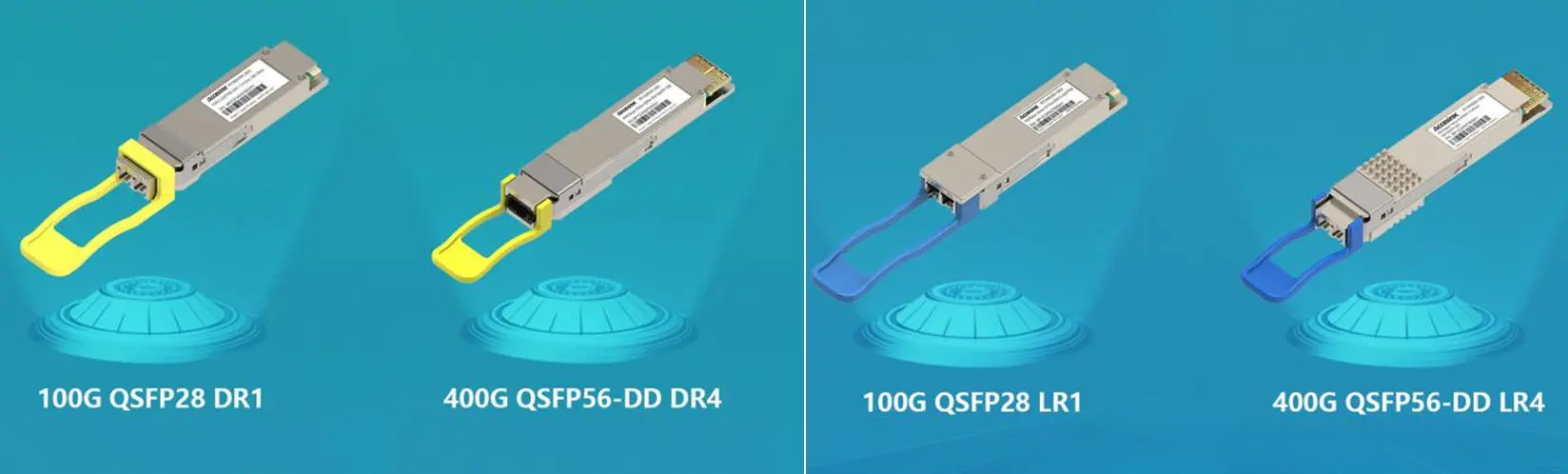
A full range of 100G & 400G OTN modules of a certain technology adopts PAM4 modulation technology and a 50GBaud/s EML laser with cooling, and selects the latest DSP chip. The single-wave 100G technology is successfully applied to the OTN transmission network. Compared with the module architecture, the single-wave 100G series modules can effectively reduce the material and manufacturing costs by increasing the transmission rate of a single channel and reducing the number of optical chips used. In addition, the power consumption of the 100G module is lower than 3.5W, and the power consumption of the 400G module is low. At 8.0W, the power consumption level is industry-leading.
This series of modules supports 400G parallel fan-out 4*100G applications, which further enriches the usage scenarios of the modules. In terms of package selection, the 100G OTN rate module adopts the mainstream QSFP28 package in the industry, and the electrical interface is in the form of 4*25G NRZ, which enables customers to smoothly upgrade existing equipment. The 400G OTN rate module adopts the QSFP56-DD package that has been deployed on a large scale in the industry, and the electrical interface is 8*50G, which is perfectly compatible with mainstream equipment in the industry. Supported rates include 100GOTN(OTL4.4electrical/OTL4.1optical), OTUCn(FOIC1.2/2.4/4.8electrical,FOIC1.1/2.2/4.4 optical), 4*OTU4 breakout(OTL4.2 electrical/OTL4.1 optical), providing a complete solution for gray-light interconnection applications between wavelength division equipment.
The 100G&400G OTN client-side optical module demonstrated by a technology is another innovative upgrade after the carrier-grade 100G LR1/ER1 and 400G LR4 single-rate modules released in 2021. In the future, a technology will continue to create more economical, efficient and reliable product solutions for customers.
At ECOC2022, a technology will cooperate with the well-known test system supplier VIAVI, DEMO 100G OTN service interconnection, 400G OTN service interconnection, and 400G OTN parallel fan-out 4*100G OTN service three application scenarios, the VIAVI ONT-800 platform will be used on site to showcase The specific products released include 100G QSFP28 DR1/FR1/LR1, 400G QSFP56-DD DR4/FR4/LR4, and the supported transmission distance is 500 meters to 10 kilometers.
A full range of 100G & 400G OTN modules of a certain technology adopts PAM4 modulation technology and a 50GBaud/s EML laser with cooling, and selects the latest DSP chip. The single-wave 100G technology is successfully applied to the OTN transmission network. Compared with the module architecture, the single-wave 100G series modules can effectively reduce the material and manufacturing costs by increasing the transmission rate of a single channel and reducing the number of optical chips used. In addition, the power consumption of the 100G module is lower than 3.5W, and the power consumption of the 400G module is low. At 8.0W, the power consumption level is industry-leading.
This series of modules supports 400G parallel fan-out 4*100G applications, which further enriches the usage scenarios of the modules. In terms of package selection, the 100G OTN rate module adopts the mainstream QSFP28 package in the industry, and the electrical interface is in the form of 4*25G NRZ, which enables customers to smoothly upgrade existing equipment. The 400G OTN rate module adopts the QSFP56-DD package that has been deployed on a large scale in the industry, and the electrical interface is 8*50G, which is perfectly compatible with mainstream equipment in the industry. Supported rates include 100GOTN(OTL4.4electrical/OTL4.1optical), OTUCn(FOIC1.2/2.4/4.8electrical,FOIC1.1/2.2/4.4 optical), 4*OTU4 breakout(OTL4.2 electrical/OTL4.1 optical), providing a complete solution for gray-light interconnection applications between wavelength division equipment.
The 100G&400G OTN client-side optical module demonstrated by a technology is another innovative upgrade after the carrier-grade 100G LR1/ER1 and 400G LR4 single-rate modules released in 2021. In the future, a technology will continue to create more economical, efficient and reliable product solutions for customers.
Related News
Read More >>
 AI Data Center Optical Evolution: Trends & Market
Sep .20.2026
With the rapid growth of artificial intelligence computing, data centers now need much more bandwidth. The physical limitations of traditional copper cable connections are becoming increasingly apparent as transmission speeds rise.
 The Global OCS Market Will Exceed $8 Billion by 2030
Sep .09.2026
The latest industry forecasts indicate that by 2030, the total size of the global optical path switch market is expected to exceed $8 billion, with a compound annual growth rate (CAGR) of over 30% between 2026 and 2030.
 400G Single-Lane: Next Inflection for AI Datacenters
Aug .27.2026
400G per lane is the next inflection for AI data centers, boosting bandwidth and scaling, but requires advances in materials, packaging, and cooling.
 AI-driven 800G Ramp-up Amplifies Quality Risks
Aug .14.2026
Faced with a surge in orders, leading global manufacturers are increasing production line speeds and shortening delivery cycles. However, the real challenge of this growth goes beyond “can we deliver orders on time?”