


Industry News
Cignal AI: North American WDM transmission spending exceeds pre-pandemic levels
Views : 981
Author : JIUZHOU
Update time : 2022-08-26 15:22:03
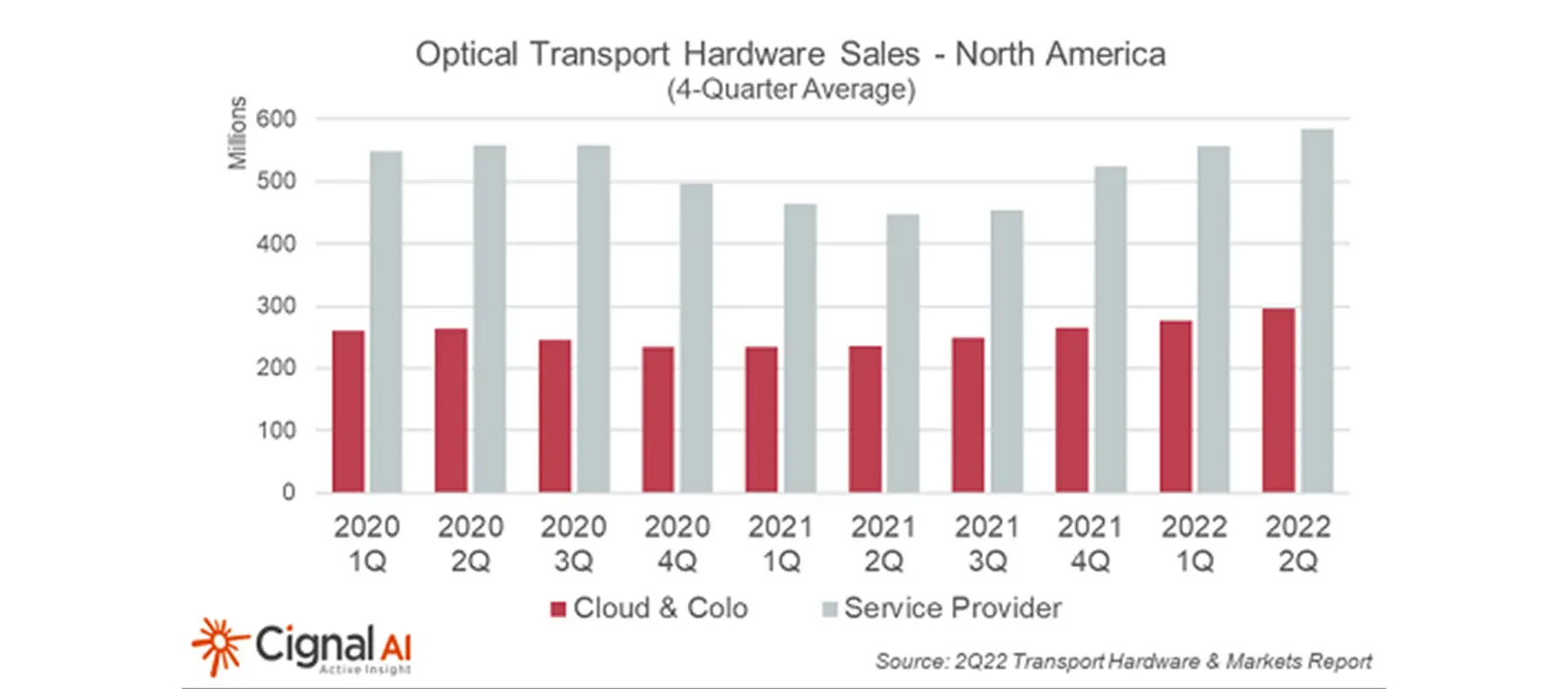
News takeaway: Equipment spending by legacy network operators and large cloud operators has now surpassed pre-COVID-19 levels in the second quarter of 2022. North American network operators spent more than 20% year-on-year on optical transport hardware, compared to weaker spending on optical and packet transport in EMEA and Asia.
Equipment spending by traditional network operators and large cloud operators has now surpassed pre-COVID-19 levels in the second quarter of 2022, according to research firm Cignal AI's latest transport hardware report. North American network operators' spending on optical transport hardware increased by more than 20% year-over-year, while European and Asian operators remained low in comparison.
Kyle Hollasch, principal analyst for transmission hardware at Cignal AI, said: "Capital investment in broadband infrastructure, the continued rollout of 5G, and pent-up demand from supply chain disruptions have driven growth in North American transmission spending. Large order backlogs and supply issues are expected to ease, It heralds a period of rapid spending growth for service providers and cloud operators in the region."
Orders remained exceptionally strong, with large suppliers generally reporting orders exceeding revenue, leading to record backlogs. Equipment suppliers said supply chain difficulties affected their ability to ship products and delayed network deployment and acceptance, delaying the recognition of some revenue.
Additional highlights from the Q2 2022 Transmission Hardware Report:
1. Global spending on optical hardware to grow 3% in the second quarter of 2022. Revenues rose in North America and China, while all other regions experienced declines.
2. Global cloud and Colo spending increased by more than 10% compared to roughly flat spending by traditional service providers. Revenues from the corporate and government segments fell year-over-year for the fifth consecutive quarter as (unusually high) spending levels during the pandemic returned to normal.
3. Cisco, Infinera and ADVA benefited the most from the increase in North American operator spending.
4. Results vary by region. North American optics revenue was the highest on record for the second quarter, while European spending fell. The decline in EMEA (Europe, Middle East and Africa) spending was due to the shift from transmission to RAN, as well as an unfavorable dollar exchange rate.
5. Global packet transport revenue increased 6%, driven by 16% growth in cloud and Colo packet spending.
6. North American packet transmission revenue grew by more than 30%, benefiting from Cisco, Nokia and Juniper. The EMEA packet transport market declined.
Equipment spending by traditional network operators and large cloud operators has now surpassed pre-COVID-19 levels in the second quarter of 2022, according to research firm Cignal AI's latest transport hardware report. North American network operators' spending on optical transport hardware increased by more than 20% year-over-year, while European and Asian operators remained low in comparison.
Kyle Hollasch, principal analyst for transmission hardware at Cignal AI, said: "Capital investment in broadband infrastructure, the continued rollout of 5G, and pent-up demand from supply chain disruptions have driven growth in North American transmission spending. Large order backlogs and supply issues are expected to ease, It heralds a period of rapid spending growth for service providers and cloud operators in the region."
Orders remained exceptionally strong, with large suppliers generally reporting orders exceeding revenue, leading to record backlogs. Equipment suppliers said supply chain difficulties affected their ability to ship products and delayed network deployment and acceptance, delaying the recognition of some revenue.
Additional highlights from the Q2 2022 Transmission Hardware Report:
1. Global spending on optical hardware to grow 3% in the second quarter of 2022. Revenues rose in North America and China, while all other regions experienced declines.
2. Global cloud and Colo spending increased by more than 10% compared to roughly flat spending by traditional service providers. Revenues from the corporate and government segments fell year-over-year for the fifth consecutive quarter as (unusually high) spending levels during the pandemic returned to normal.
3. Cisco, Infinera and ADVA benefited the most from the increase in North American operator spending.
4. Results vary by region. North American optics revenue was the highest on record for the second quarter, while European spending fell. The decline in EMEA (Europe, Middle East and Africa) spending was due to the shift from transmission to RAN, as well as an unfavorable dollar exchange rate.
5. Global packet transport revenue increased 6%, driven by 16% growth in cloud and Colo packet spending.
6. North American packet transmission revenue grew by more than 30%, benefiting from Cisco, Nokia and Juniper. The EMEA packet transport market declined.
Related News
Read More >>
 AI Data Center Optical Evolution: Trends & Market
Sep .20.2026
With the rapid growth of artificial intelligence computing, data centers now need much more bandwidth. The physical limitations of traditional copper cable connections are becoming increasingly apparent as transmission speeds rise.
 The Global OCS Market Will Exceed $8 Billion by 2030
Sep .09.2026
The latest industry forecasts indicate that by 2030, the total size of the global optical path switch market is expected to exceed $8 billion, with a compound annual growth rate (CAGR) of over 30% between 2026 and 2030.
 400G Single-Lane: Next Inflection for AI Datacenters
Aug .27.2026
400G per lane is the next inflection for AI data centers, boosting bandwidth and scaling, but requires advances in materials, packaging, and cooling.
 AI-driven 800G Ramp-up Amplifies Quality Risks
Aug .14.2026
Faced with a surge in orders, leading global manufacturers are increasing production line speeds and shortening delivery cycles. However, the real challenge of this growth goes beyond “can we deliver orders on time?”