


Industry News
II-VI wins $100 million contract to supply SiC substrates for power electronics
Views : 935
Update time : 2022-08-19 21:13:45
Introduction: II-VI Corporation Completes a Contract of More than $100 Million to Provide 150mm Silicon Carbide Substrates to Tianyu Semiconductor.
On Wednesday, II-VI Corporation (Nasdaq: IIVI), a leader in wide-bandgap compound semiconductors, announced today that it has completed a contract valued at more than $100 million to supply Dongguan Tianyu Semiconductor Technology Co., Ltd. with 150mm silicon carbide-based piece. Deliveries are from the start of this quarter to the end of calendar year 2023.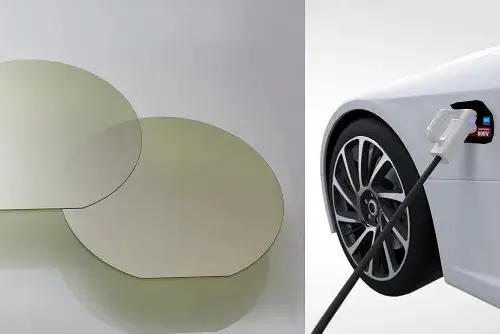 The electrification of transportation infrastructure and industrial equipment is accelerating the market transition to power electronics based on the third-generation or wide-bandgap semiconductor silicon carbide (SiC). Compared to state-of-the-art silicon-based devices, silicon carbide enables smaller, more efficient power electronics with lower system-level total cost of ownership. Tianyu is one of the earliest and largest SiC epitaxial wafer manufacturers in China. The company has signed a long-term supply contract with II-VI to secure capacity for 150mm SiC substrates for its 2023 needs.
Sohail Khan, Executive Vice President, New Ventures & Wide-Bandgap Electronics Technologies Business Unit, said: "In November 2021, we were delighted to announce that Skyfield select II-VI as its primary A strategic partner for the supply of 150mm SiC substrates for power electronic devices. With the substantial increase in end-use demand, Skyfield must secure its supply through this long-term, high-volume contract, which will be recurring and follow-up Its value grows over time.”
To meet the needs of the Asian market, II-VI has established a back-end processing line for SiC substrates in 2021 at II-VI's "Asia Regional Headquarters" in Fuzhou, China, with a clean room area of over 50,000 square feet. Tianyu will benefit from II-VI's global 150mm SiC capacity in the US and China.
Skyspace and II-VI will provide a high-quality and reliable supply chain and future 200mm capabilities to support large market demands such as electric vehicles (EVs), renewable energy, smart grids, microgrids and data network power, which are critical to The rapid growth of SiC power electronics is critical. Tianyu is well positioned to serve the power electronics market for electric vehicles in China. China is currently the world's largest electric vehicle market.
Given their wide range of applications, SiC-based power electronics have a very beneficial impact on the environment by significantly reducing CO2 emissions and energy consumption.
On Wednesday, II-VI Corporation (Nasdaq: IIVI), a leader in wide-bandgap compound semiconductors, announced today that it has completed a contract valued at more than $100 million to supply Dongguan Tianyu Semiconductor Technology Co., Ltd. with 150mm silicon carbide-based piece. Deliveries are from the start of this quarter to the end of calendar year 2023.
Sohail Khan, Executive Vice President, New Ventures & Wide-Bandgap Electronics Technologies Business Unit, said: "In November 2021, we were delighted to announce that Skyfield select II-VI as its primary A strategic partner for the supply of 150mm SiC substrates for power electronic devices. With the substantial increase in end-use demand, Skyfield must secure its supply through this long-term, high-volume contract, which will be recurring and follow-up Its value grows over time.”
To meet the needs of the Asian market, II-VI has established a back-end processing line for SiC substrates in 2021 at II-VI's "Asia Regional Headquarters" in Fuzhou, China, with a clean room area of over 50,000 square feet. Tianyu will benefit from II-VI's global 150mm SiC capacity in the US and China.
Skyspace and II-VI will provide a high-quality and reliable supply chain and future 200mm capabilities to support large market demands such as electric vehicles (EVs), renewable energy, smart grids, microgrids and data network power, which are critical to The rapid growth of SiC power electronics is critical. Tianyu is well positioned to serve the power electronics market for electric vehicles in China. China is currently the world's largest electric vehicle market.
Given their wide range of applications, SiC-based power electronics have a very beneficial impact on the environment by significantly reducing CO2 emissions and energy consumption.
Related News
Read More >>
 AI Data Center Optical Evolution: Trends & Market
Sep .20.2026
With the rapid growth of artificial intelligence computing, data centers now need much more bandwidth. The physical limitations of traditional copper cable connections are becoming increasingly apparent as transmission speeds rise.
 The Global OCS Market Will Exceed $8 Billion by 2030
Sep .09.2026
The latest industry forecasts indicate that by 2030, the total size of the global optical path switch market is expected to exceed $8 billion, with a compound annual growth rate (CAGR) of over 30% between 2026 and 2030.
 400G Single-Lane: Next Inflection for AI Datacenters
Aug .27.2026
400G per lane is the next inflection for AI data centers, boosting bandwidth and scaling, but requires advances in materials, packaging, and cooling.
 AI-driven 800G Ramp-up Amplifies Quality Risks
Aug .14.2026
Faced with a surge in orders, leading global manufacturers are increasing production line speeds and shortening delivery cycles. However, the real challenge of this growth goes beyond “can we deliver orders on time?”